What is SEO? Basics of search engine optimization for 2018!
What is SEO?
In this article, I want to explain what SEO actually is? What are the challenges we have in Search Engine Optimization (SEO)? And which optimization approaches help you to get better results on Google in the natural search?
SEO (Search Engine Optimization) or search engine optimization is to make content that can be indexed by search engines appear in the search for content-relevant search terms (keywords) at the highest possible positions. It depends not only on the position itself but also on the match between the search term, search result representation and relevance, with the aim that the user can efficiently solve his task (Task completion) on the website.
The goal of search engine optimization
The goal of SEO is therefore not just to be on top. The presentation of the text available in the search engines (snippet) should motivate the user to click on your result. The goal is to satisfy the user's expectation regarding the content match between the search term, snippet and relevance of your website.
Search engine optimization has the goal to be represented with relevant pages on relevant positions in the relevant search engines or relevant search terms. For example, these search engines can be search engines like Bing, Yahoo or Yandex, but also specialized search engines like Amazon (Product Search), Indeed (Job Search) or Trivago (Hotel Search). The presentation of the text available in the search engines (snippet)The aim is to motivate the user to click on the result with the aim of fulfilling the expectation of the user in terms of the content match between search term, text and content of the website. Prerequisite is the clear and unambiguous access to the entire relevant website and optimally prepared for users, regardless of the device (mobilfeundlich).
Web analysis and information architecture as support for search engine optimization
The user expects the search term, snippet and content of the website to match. This substantive agreement can be analyzed using key figures that we collect in Google Analytics, for example. Good indicators are here, for example
bounce rate
Average session duration
Pages / Visit
or conversion rates
Further support for a better understanding of search engine optimization can also be found in the information architecture, which helps to better understand what users expect from your web pages. In the following graphic, you will find important elements of the information architecture and about which measure you also get an improvement of the user experience.
Note: We have written a very detailed article, which actually means the bounce rate in Google Analytics.
The different areas of SEO
Typically, search engine optimization is divided into the following areas:
Keywording: Development of keyword strategies
Technical SEO: technical optimization, such as site-speed, crawling and indexing
OnPage optimization: content, metadata, structure or
Information Architecture: Sense of Place & Informationsscent etc.
Off-page optimization: internal and external linking:
Content Marketing: Gain users about meaningful content
Mobile SEO: mobile optimization and mobile friendliness
SEO KPIs: Measuring success using meaningful key figures
Note: If you are interested in the subject of content marketing, then we recommend our article on the definition of content marketing. The extended optimization of the presentation of results in the form of snippet optimization is also gaining in importance. For example about rich snippets.
Definition SEO on Wikipedia
Search Engine Optimization (SEO) refers to measures that serve to ensure that content such as web pages, videos and images in the organic search engine ranking appear in the unpaid search results (Natural Listings) in higher places. By deliberately influencing the search engine placements of, for example, videos on the platform YouTube or websites on Google, these can be better listed and generate new reach.
Source: Definition Search Engine Optimization Wikipedia
Demarcation and interaction of SEA and SEO
Search engine optimization ( Search Engine Optimization - SEO ) is a branch of search engine marketing (Search Engine Marketing - SEM ). The second portion of search engine marketing (SEM) is the search engine advertising ( S earch E ngine Advertising - SEA ), such as Google AdWords or delivery of Bing Ads. Usually one tries to reach over search engines always users, who have a very concrete need. But the main differences between SEO and SEA are
Billing system: Google AdWords has a variable billing model (cost-per-click). Search engine optimization is not free but differs in the billing form, which is usually project-related.
Effect: Google AdWords is very performance-oriented and has clear metrics (impressions, CTR, CPC, RPC), at a reasonable cost. Search engine optimization is more like public relations. By bundling many useful measures you increase the probability of getting good positions, but nobody can guarantee you a top position.
Keyword Strategies: The focus in SEO is on specific relevant search terms or search term clusters. With paid search, it's also possible to bid on adjacent search terms, even if they have a bad AdWords Quality Score. In the end, the conversion counts here. An example of advanced keyword strategies would be for our terms, such as SEO seminar or SEO training, on which we optimize ourselves (SEO). Nevertheless, we extend the application (Google AdWords) our own seminars on terms, such as SEO training, education etc via Google AdWords.
The 6R of Search Engine Optimization:
First of all in a nutshell our own SEO definition :
Search engine optimization (SEO) includes all strategies and tactics to be sustainably represented for relevant search terms or topics with relevant pages on the optimal positions in the relevant search engines . With the goal of achieving meaningful conversions for the company.
Relevant search engines are not just Google or Bing. In addition to Google's "main index," vertical search services such as Google News, Google Images, or Google Maps ( Local SEO ) may also be relevant. But also search systems, like the optimization for Amazon (Amazon SEO), jameda, Monster, Slideshare or Youtube or Stepstone can be important for search engine optimization.
With suitable SEO tools and analysis tools, search engine optimization regularly checks:
which are the right keywords -> relevance
how visible your own website is in the search results -> Reach
at which positions you are with the relevant keywords -> Rankings
What is the CTR in the Search Engine Result Pages (SERPs) -> Response
how users behave on the page based on the search terms entered -> Reaction
whether all measures of search engine optimization also lead to a demonstrable achievement of economic values -> Results
These six terms make up the 6 R of search engine optimization. Do you want to analyze your page immediately? Then find here our 27-page guide SEO analysis for free download.
Relevance - Choose the right keywords and topics
The basis of every search engine optimization is the search, evaluation, review and extension of the relevant search terms or topics. In my opinion, this basis is often ignored too quickly.
Here are the different levels:
1. The search for search terms
The aim of researching search terms is to understand the users as precisely and as comprehensively as possible. In order to find the right keywords, they often come up with their own ideas, use keyword tools, and search competitors' websites. In a first step, a search term list that is as extensive as possible should be researched in this way.
Choosing the right keywords is a management decision: choosing the right keywords will make it easy to reach users in the right decision-making phase at the right time. Selecting the right keywords has a direct impact on
the probability of good positions.
the conversion probability.
the brand perception.
2. The evaluation of search terms
In a next step, the search terms are evaluated. To do this, you determine:
Quantitative analysis: how often the researched search term is searched on Google and other search engines.
what intention a user has when entering a search term. Is he looking for information ( information orientation ), for a specific company or brand ( navigation orientation ) or does he want to buy ( transaction orientation )?
whether the term is an evergreen with consistently high search volume. Typical evergreens are "weather", "route planner", "online marketing".
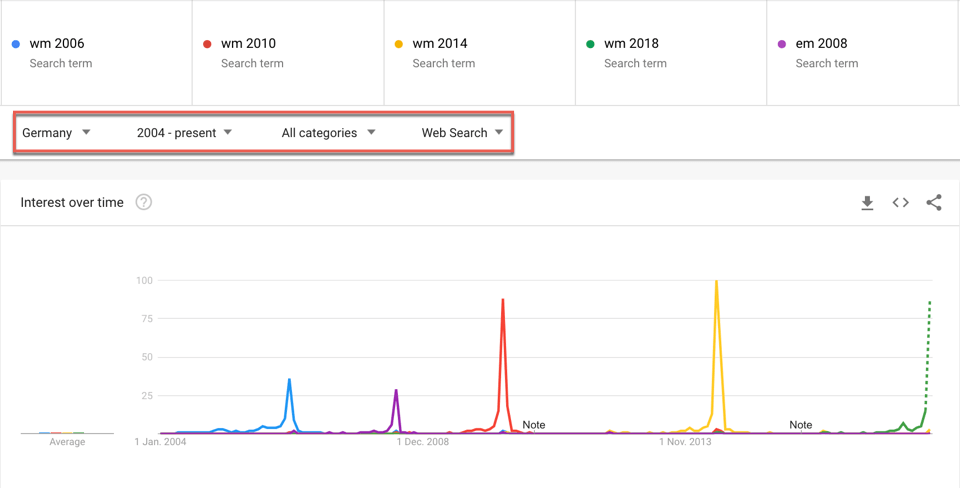
whether the term is an event with regular recurring volume. Typical events are "CeBit 2018", "iPhone 8", "Football World Cup 2018" or "Annual Horoscope 2018".
whether the term is a current event, that is a search term that suddenly shows a strong increase. Typical current events are natural disasters and deaths.
In which purchase decision phase the user is. If the user, even at a very early stage of the search, searches for comparative content or is about to start a transaction.
Further criteria for the evaluation of a search term are:
volume
competition
The potential for optimizability (wording, CI guidelines)
Possible conversion rates (from SEM experience)
Plural or singular
Seasonal fluctuations
Strategic meaning
Synonym ("Training", "Course", "Seminar")
trends
Negative criteria: brand names of competitors, prohibited terms, terms with too many words or characters
3. The review and extension of the search terms
It makes sense to check the list created in the previous step also regularly. Since Google has not been able to provide really accurate numbers in its Keyword Planner since June 2016, it may make sense to first test your terms using Google AdWords for search engine optimization keywords that are particularly relevant.
For example, you want to find out:
What is the exact search volume for specific terms?
What is the CTR on different ad text?
which product features or USPs convince your users
How high conversion rates are for your search terms
Relevant metrics for an upstream AdWords experiment to define your perpetual keyword strategy are:
the number of impressions (what is the actual search volume?)
the amount of clickthrough rate (test product features and USPs)
the number of bounce rates (are your users dealing with your content)
the number of conversion rates (you really want to buy your users).
Google Trends for advanced search terms analysis
Even after initial optimization approaches, your own keyword set should be checked regularly:
What is the behavior of users who have come to their own site using exactly these keywords?
What are the actual bounce rates?
Which keywords really lead to a conversion?
Are there any new terms that are interesting for optimization?
How is my visibility developing?
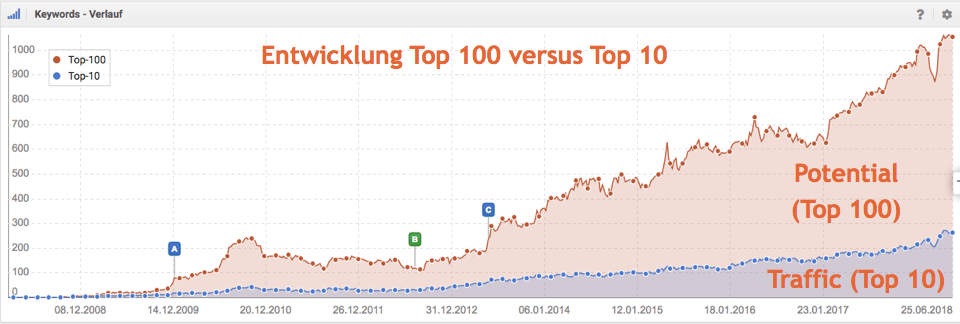
How is the number of search terms developing in the Top 100 (Potential) and Top 10 (Sessions)?
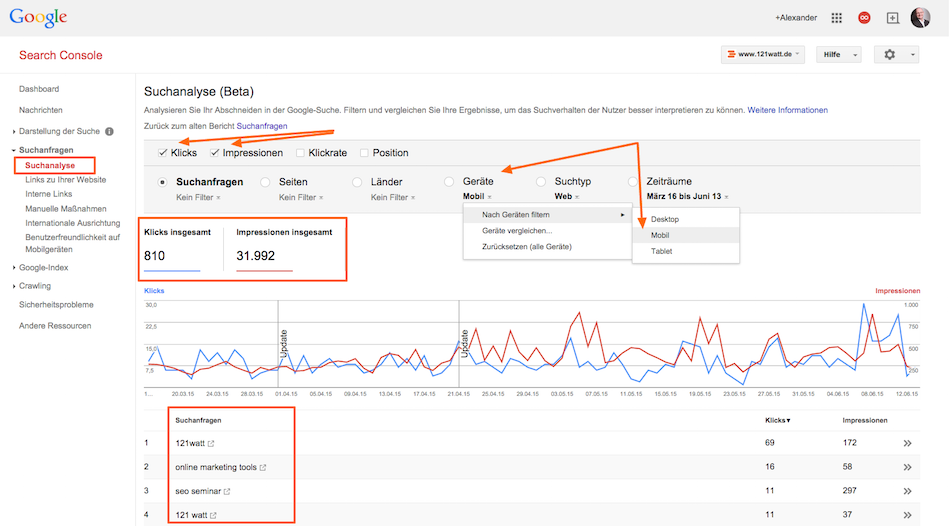
Since October 2011, Google's search results pages are encrypted. The consequence: in-web analysis tools, like Google Analytics, you no longer receive keyword data, but it is only (not provided) identified as a keyword. Of course, that's a pity, so I recommend you Google Search Console for keyword search:
Search for keywords: strategic versus tactical
Search for keywords generally has two dimensions: strategic and tactical.
Strategic: For which terms do you want to be found overall?
Tactical: If, for example, you are producing a single article for your content marketing, then the question is for which search terms this single article should be found. This will help you then tools like uber suggest.
Conclusion: Choosing the right keywords will help you decide how to engage your users on Google at the right time, at the right time. Choosing the right keywords has a direct impact on that
the probability of good positions.
the conversion probability.
the perception of your brand.
Reach - the visibility in the search engines
One could call the Reach also in old marketing German as "Share of Voice". In search engine optimization, the term visibility has prevailed.
This term was coined by SEO tool providers like SISTRIX or Searchmetrics.
The visibility refers to two factors:
The number and volume of search terms a domain appears on Google
The positions occupied by these search terms
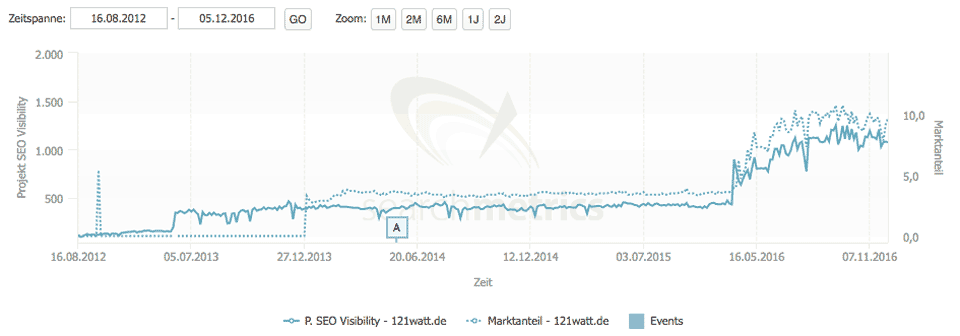
You can measure the reach, or the visibility, with tools, such as Searchmetrics. But even with the Google Search Console, you can see very well how the impressions of your own domain have changed over time.
The visibility of 121watt.de in Searchmetrics
Both SISTRIX and Searchmetrics use the visibility to first review a website. In SISTRIX this value is VisibilityIndex called and Searchmetrics is the SEO Visibility spoken.
And so both indices are formed:
The SEO Visibility (Searchmetrics) of a domain consists of the search volume and the positions of the keywords that grow for this entry. Searchmetrics uses a factor to weight each position. It also takes into account whether they are keywords with a navigational or informational search interest.
For the Visibility Index (SISTRIX), the top 100 positions are analyzed for a large set of common keywords for a country. Subsequently, weighting is also made here according to search volume and position. For example, a bad position on a popular keyword pays more heavily to the index than a good position on a low-hit keyword. Here's how Sistrix defines his own visibility and how you interpret it in detail.
Mobile Visibility: As a ranking factor since 2015, it also counts whether your site is mobile-friendly. That's why you can now use both tools to evaluate your mobile visibility.
Although the values of SISTRIX and Searchmetrics are not comparable, they are in themselves a good way to quickly check (SEO) problems with your website and compare yourself to the competition.
The course is crucial
Interesting for the search engine optimization is not only snapshots but in particular changes over a period of time.
The question is: why did change happen?
Reasons for a change in the visibility process are:
own optimizations
the optimizations of competitors who have an influence on their own visibility
new content
Loss/gain of external signals, such as links
successful or failed relaunches
technical reasons, such as the exclusion of pages/directories
technical issues, such as duplicate content
individual penalties by Google
general revaluation of your site via signals, such as the Panda or Penguin update
Thus, the reach or the visibility is an effective indicator in order to become aware of changes in the search result lists in the first place. In addition to visibility, however, real data, ie meetings and conversions (from Google Analytics, for example) should always be taken into consideration.
Rankings - at these positions is your website with your search terms
Even though the relationship between reach and rankings is very high, it must be differentiated here:
Rankings are the crucial criterion for getting the chance to click. However, the rating of the positions is not enough to enter his set of search terms on Google and to check where one appears.
Because that is complicated by Google's two aspects:
context
personalization
Among the context criteria include, for example:
language
country
place
time
Among the Personalisierungskrtiterien include:
your own search history
the own click behavior
Personalization can be prevented by using an incognito window in your browser or by appending the parameter & pws = 0 to the result URL.
However, the context remains despite the possibilities just described. Since the Venice - the Pidgeon -. and last but not least the Possum update, the context has become even more important for implicitly local search queries. The result: A query on a general term, as in our case "Online Marketing Seminar" leads to different rankings depending on the regional context.
Here's an example:
Despite the increase in context and personalization at Google, rankings in SEO need to be reviewed. It is not always about absolute values, but about indicators for search engine optimization.
These values are helpful in the analysis:
Number of search terms in the top 100
Number of search terms in the top 10
Number of search terms in the top 4-10
Number of search terms in the top 3
Number of search terms on Top 1
Percentage distribution of search terms on the individual result pages
Relationship of Branded Searches to Non-Branded Searches
Average rankings for the top search terms
Visibility of individual keyword clusters
Visibility of individual pages and directories
<div class = "tip"> Note : It's also important to look at the results in Google Analytics:
How are accesses from the organic sector changing?
How many urls actually get access from Google's organic index?
How strongly do visibilities correlate to real analytics numbers? </ Div>
Visibility: tactics and measures
To increase visibility, these measures should be on the plan:
Content strategy and content marketing
OnPage Optimization
Page load speed
internal and external linking
For large websites with a lot of content (media, blogs, publishers) aspects such as internal linking, information architecture, crawling and indexing play an even stronger role.
Mobile First and Search Engine Optimization
Ever since the mobile-friendly from April 2015 and May 2016, the entire topic of mobile friendliness is also set for the SEO. Furthermore, Google announced in November 2016 that in future the mobile index will be the main index. This announcement from November 2016, Google has now been synonymous with your Mobile First Index by the end of March 2018 implemented. Aspects of how to tune in to the Mobile First Index are:
Crawling: Are there any problems crawling the mobile site?
Mobile friendly: Can the website be used with smartphones?
Content: Are the important content on the mobile website included?
Content II: Are content presented as mobile friendly?
Connection: Can Google tell if a content page is offered for and connects to both mobile and desktop?
Further information about the Mobile First Index can be found here.
Mobile optimization and page loading speed
Google announced on January 17, 2018, that as of July 2018, mobile page search speed is a ranking factor. Even though it's Google's first priority to spot slow pages, this again is a clear indication that Page Speed is one of the key factors. For example, Google recommends tools such as Lighthouse, or the Chrome Page Speed Insights extension, to help you analyze weaknesses on your own page.
<div class = "tip"> For all those who want to analyze their mobile strategies better, there is a blog post on the topic: Mobile users and mobile website traffic better with Google Analytics (https://www.digitalfarmer.me/analyse optimize / mobile-user-with-google-analytics-analyze /) understand. </ div>
Response - so high is the clickthrough rate in the SERPs
Good positions are a prerequisite for the click. However, it is crucial if users really click on your snippet (result).
The first hint comes from two possible sources of analysis. On the one hand from the Google Search Console, which shows not only impressions but also clicks and the CTR, on the other hand from the real numbers of the Web analysis.
In the picture below you can see figures from one of our projects: 434,718 impressions at 9,816 clicks. This results in a click rate of 2.25% for the whole page.
Whether users actually click on your snippet depends on a number of factors:
What is the position of your result?
Snippet Design: How good are your titles and descriptions?
Awards, such as Deeplinks (good information architecture)
Rich snippets, such as reviews
Brand: How familiar and trusting is your brand?
Competition with vertical integrations, such as Google News or Google Image Search
Competition by Google Adwords
Update from December 2017: Important in this context, that Google also makes changes here in the presentation of the snippets again and again. So Google has to 01. December, the length of the snippets, to be more precise the description of about 150 characters in the standard to about 300 increased. in the field of mobile search, it is now more about the 225 characters.
Update from May 2018: In the meantime, Google has taken back the extension of the descriptions to 300 characters and according to own statements has gone back to a length that is slightly longer than before. So about 160 characters, but the Enda Google has a reservation here, which means if necessary, we also change the length, as long as it makes sense for the user.
Response: tactics and measures
The response can be optimized with these strategies:
Link marketing or link building
Technical Optimization (Rich Snippets)
OnPage optimization with emphasis on snippet optimization
Building your own brand through other channels
The best indicators to measure the success of your response SEO strategy come from the Google Search Console and is the ratio of impressions to clicks (CTR). But also look in detail for a single document (URL), which search terms lead to high click rates and low click rates.
Reaction - this is how users behave based on the entered search terms
Assessing users has not been easy with users since the search results were encrypted. Encryption does not pass users' search terms to web analytics tools, such as Google Analytics.
In Google Analytics, these search terms are marked as (not provided). The changes since the introduction on 18 October are quite dramatic. The consequence: All evaluations based on search terms are falsified. Straightforward considerations in time comparison are so difficult to interpret.
Despite the best search and optimization of the search, the user decides how relevant the page is in the context of his entered search term.
Indicators of high relevance are these factors:
Bounce rate or bounce rate
length of stay
Pages per visit
Conversion rate - macro and micro conversions
Since the search for the search terms is, as I said, no longer very easy, we combine two analysis approaches here:
On the one hand, we look at the relevance based on the search terms
On the other hand, we also look at the behavior of users when they visit landing pages when they come from the organic sphere
Google Analytics Report:
Here is a downloadable report we have compiled for the analyze. The goal is the efficiency measurement of the pages:
Report Based on entry KWs / Filter Organic (SEO sessions) - download here for Google Analytics
Reaction: tactics and measures
The tactical measures to optimize the reaction are in the focus:
Informationsarchitekur
Layout and design
Internal Linking
Conversion Optimization
Especially the conversion optimization is important here, because, for Google, the behavior of users as a signal is becoming increasingly important. These user signals, called Longclicks or Shortclicks, are important in determining whether the result was good or bad for a user.
The Panda Update, first released in February 2011 in America and on 12.08. has been rolled out in Germany, has tried to recognize whether the content that you generate for your users are also really helpful and the user can do their job as best as possible on your site.
Results - Does the optimization also lead to a demonstrable achievement of economic goals?
What counts in the end are results. And not just the short-term and instant.
In the recap to a Conversion Summit we have from the lecture of "Mr. Web Analytics "Avinash Kaushik compiled the following thoughts:
if convert 2%, what's the rest? The 2% are the ones that make up the direct sales. But too often we do not focus on the remaining 98 %.
In addition to the immediate macro conversions, are there any micro conversions that do not have an immediate, but a medium or long-term economic value?
List of possible micro conversions
Creating wish lists
Newsletter Registration
Write a review
Become a Facebook fan
Go to a store locator
Calling specific, strategically important company pages (product pages)
Request for an information package
In addition to considering the ROI of search engine optimization should be in addition to the input factors
Budgets for resources
consultant
Know-how
seminars
Tools
processes
also, keep an eye on the output in terms of macro conversions and micro conversions.
SEO makes websites better
One aspect of optimization that can not always be directly attributed to (sustainable) search engine optimization is that it leads to better websites:
Improvement of page speed -> reduction of bounce rate, the increase of pages/visit, higher conversions